
Fluorescence in Natural Yellow, and light yellow Diamonds
This article will discuss the effect of Fluorescence on Natural Yellow, and Light Yellow Diamonds. This is an intricate subject in colorless and near colorless diamonds, discussed in an excellent article here . In fact, this characteristic may have an even greater visual effect on diamonds that exhibit a lot of body color.
What is fluorescence?
In the photo above the stone on the left is reacting to an ultra-violet light.
Fluorescence is a characteristic that describes the effect of ultra violet light on some diamonds. This characteristic causes a diamond to react to ultra violet light. A common light source for looking at diamonds is the sun, which is rich in UV rays. Therefore sunlight may noticeably "activate" the fluorescence in Medium or String Blue stones . The greater the degree of fluorescence, the greater the effect. Diamonds that are not fluorescent are referred to as "inert"
How does fluorescence affect diamonds in general?
In the most cases, fluorescence does not cause a haze. For the purposes of this discussion, let's assume the fluorescence referred to is the type that has does not cause a diamond to appear "hazy." Only a very small percentage of polished diamonds will be affected in this way by fluorescence. In my experience, an ultraviolet light is unnecessary to weed out these dull stones- it's obvious in virtually any lighting environment.
In a fair percentage of fluorescent diamonds, you will need a UV lamp to detect it. There are cases where sunlight brings out blue color in white diamonds.
When it comes to yellow diamonds, fluorescence more frequently gives diamonds a chameleon like nature. To understand Fluorescence in colored diamonds, we can begin by looking at the way it affects colorless stones.
If we were considering fluorescence in colorless diamonds, the actual degree of change is greater as you go down the color scale. That is to say: a D color, Medium Blue, when exposed to sunlight, may look slightly blue- but the body color of the diamond is so slight that the stone can't really look much whiter. We might put a J color in direct sunlight, and have it look like an H. That is to to say, a J may show more color change due to fluorescence than a D.
As we go "down" the color scale to faint yellow, light yellow and darker yellow diamonds, the perceived color swings may be more extreme. Some diamonds graded as dark as Fancy Intense Yellow may lose a large degree of yellow color in direct sunlight and actually look pale. Making this all the more complex is the fact that some Intense yellow diamonds that are strong blue show very little effect in sunlight- requiring the dark field and UV light to detect.
GIA and grading of Yellow diamonds that Fluoresce
It appears that the GIA attempted to solve the colour grading and transparency issues with its study published in 1997. However Mr. Haske has shown that after this report the GIA, apparently, without adequate notification, introduced grading lamps with a similar amount of long wave ultra violet radiation as found in indirect daylight.
The above is quoted from the conclusion of the Garry Holliway article
I have noticed that Medium or Strong Blue stones of a given Fancy Yellow color grade look more yellow than inert stones of the same color grade. Based on Garry's conclusion we can see evidence that the use of grading lamps with similar amount of long wave UV as indirect daylight affects how GIA grades yellow diamonds. Basically, it seems to me, and many dealers that we speak to in fancy colors that GIA grades Fluorescent Yellows differently than inert stones. GIA is tougher on stones with fluorescence so that these stones end up looking, darker in normal room lighting than other stones of the same grade
Whether or not anyone may feel fluorescence is detrimental, the market punishes Fancy Yellow, Fancy Intense Yellow, or Vivid yellow stones graded Medium Blue or Strong Blue by GIA. A good fact for those shopping yellow diamonds to keep in mind.
Other Colors of Fluorescence
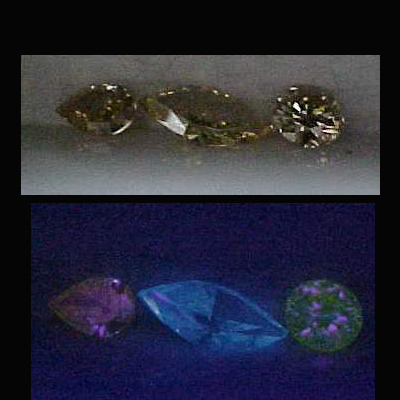
In the photo above the stone on the left
exhibits orange fluorescence, the middle stone blue, and the stone on the right yellow
.
Conclusion
In summary- Natural Yellow diamonds with Fluorescence can be very pretty- many buyers of this type of stone will enjoy any potential color change effect caused by this characteristic.
In the darker grades, which are more costly, the color change effect may be dramatic. Stones Medium of Strong Blue trade at slightly lower prices compared to inert stones